
Resin vs Ceramic vs Cast Iron vs Stainless Steel Kitchen Sink: Which Is Best? (2026)

By Julian Gill Updated · 7 min read
Disclosure: Some of the links in this article may be affiliate links, which can provide compensation to me at no cost to you. You can read our affiliate disclosure in our privacy policy.
In this article
- Kitchen Sink Materials at a Glance
- Cast Iron Kitchen Sink
- American Standard 77SB30190.308 Delancey Cast Iron Sink
- Ceramic Kitchen Sink
- DeerValley DV-1K028 Ceramic Farmhouse Sink
- Resin Kitchen Sink
- Kraus KGD-54GREY Forteza Granite Composite Sink
- Stainless Steel Kitchen Sink
- Kraus KHU100-32 Standart PRO 16 Gauge Stainless Steel Sink
- How to Choose the Right Sink Material
- Stainless Steel
- Cast Iron
- Ceramic
- Resin or Composite
- Our Recommendation
- FAQs
Your kitchen sink gets more use than almost anything else in the house: hot pans, heavy pots, dropped glasses and harsh cleaners. The material it is made of decides how well it survives all that and how it looks ten years from now. Here I compare the four most common choices: resin, ceramic, cast iron and stainless steel.
Quick answer
Stainless steel is the best all-round kitchen sink material for most homes: durable, easy to match and reasonably priced. Choose enameled cast iron for a classic, solid sink in a color, ceramic for a farmhouse look, and resin or composite for an easy-to-clean sink that blends with the countertop.
Key takeaways
- Stainless steel: the most common and the safest choice, but it shows scratches.
- Cast iron: very durable, heavy, and its enamel color does not fade.
- Ceramic: beautiful and stain resistant, but it can chip.
- Resin: easy to install and clean, but less durable than the others.
- Care matters: every material lasts longer with non-abrasive cleaners.
Kitchen Sink Materials at a Glance
| Material | Durability | Look | Main weakness | Best for |
|---|---|---|---|---|
| Stainless steel | Very high | Modern, fits most kitchens | Scratches easily | Most kitchens and heavy daily use |
| Cast iron | Very high | Classic, glossy, many colors | Heavy, enamel can chip | Traditional and high-end kitchens |
| Ceramic | High | Farmhouse, mostly white | Can chip or crack | Farmhouse and cottage styles |
| Resin / composite | Moderate | Matte, stone-like colors | Less heat and wear resistant | Easy care and seamless looks |
Cast Iron Kitchen Sink
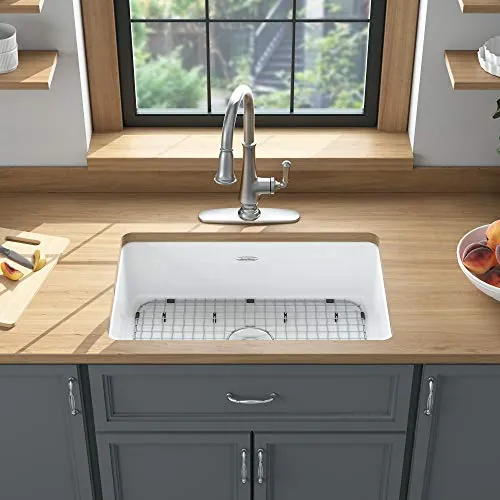
Cast iron is one of the most durable materials used for kitchen sinks. The iron body is covered with a thick porcelain enamel coating, which gives it a deep, glossy finish. That enamel comes in a wide range of colors and is a favorite in many high-end kitchens.
The weight is part of the appeal: a cast iron sink feels rock solid and is quiet when you drop a pan in it. It also holds heat, so dishwater stays warm longer. The flip side is that the weight needs a strong cabinet, and undermount installs need solid support.
Pros
- Enamel color will not fade over time
- Often made with recycled iron
- Holds heat well, so dishwater stays warm
- Quiet and very solid
Cons
- Enamel can be scratched by harsh abrasives or chipped by heavy impacts
- Very heavy, needs a strong cabinet
- Can be on the expensive side
Ceramic Kitchen Sink
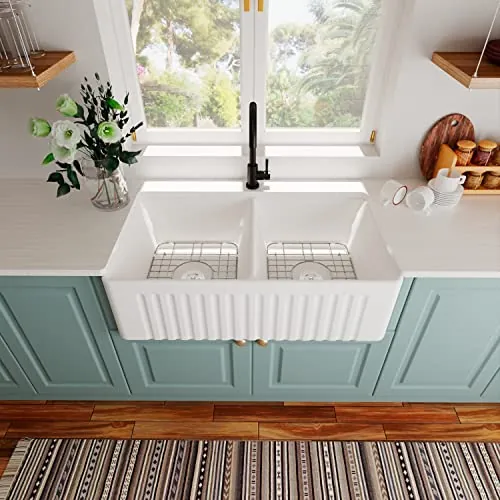
Ceramic sinks are made from clay fired at high temperature and finished with a glaze. White is by far the most common color, but custom-made sinks can be ordered in colors that match your kitchen. Because each one is shaped and fired, no two ceramic sinks look exactly alike.
The glazed surface resists stains and does not dent. It can chip, though, if you drop a cast iron pan or a heavy pot on the edge. Clean it with non-abrasive cleaners only, and it will keep its shine for many years.
Pros
- No two ceramic sinks look exactly alike
- Resists denting
- Wide range of colors
- Sealed, glazed surface resists staining
Cons
- Manufacturing is energy intensive and less eco-friendly
- Chips more easily than some other materials
- Heavy, especially in farmhouse sizes
Resin Kitchen Sink
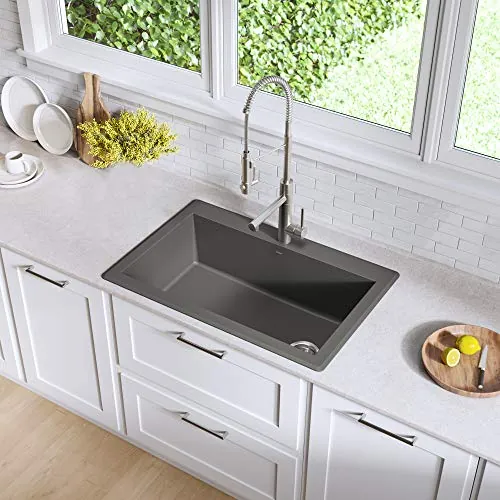
Resin sinks are made from man-made compounds, usually epoxy or acrylic resin, sometimes mixed with crushed stone. The resin can be molded into a sink alone or into a countertop and sink in one piece, and drop-in models fit a wide range of kitchen styles.
The Kraus Forteza above is a granite composite: crushed granite held together with resin. Composites like this are harder and more heat resistant than plain resin, which is why they are popular. Either way, the matte, non-porous surface is very easy to keep clean.
Pros
- Resists stains and many household chemicals
- Easy to install, light to handle
- Very easy to keep clean
- Can be molded with the countertop for a seamless look
Cons
- Not as durable as stainless steel or cast iron
- Can be marked by very hot pans or boiling water
Stainless Steel Kitchen Sink
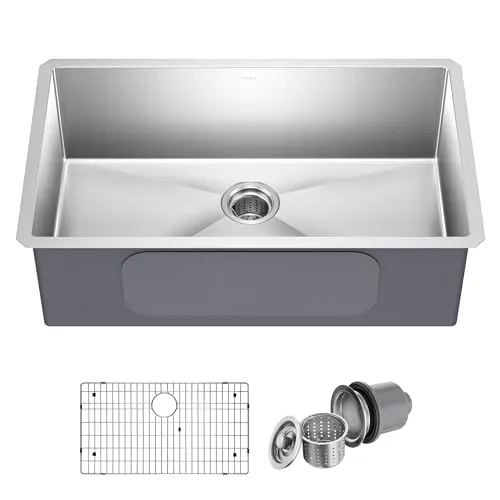
Stainless steel is by far the most common kitchen sink material, and you will find it in everything from starter homes to high-end kitchens. It goes with nearly every countertop, cabinet and faucet finish.
A good stainless sink lasts for decades when it is cared for. It will not chip or crack, and it handles hot pans and heavy pots without trouble. The trade-off is that it shows scratches and water spots. Thicker steel (a lower gauge number, like 16 gauge) is stiffer and quieter, and a bottom grid protects the floor of the bowl.
Pros
- Lasts for decades with basic care
- Very durable: no chips or cracks
- Fits most kitchen color palettes
- Handles heat well
Cons
- Little variety in color
- Scratches easily
- Shows water spots in hard water areas
How to Choose the Right Sink Material
Best for most kitchens
Stainless Steel
Pick it for heavy daily use, a modern look and the best balance of durability, looks and price.
Best classic look
Cast Iron
Pick it for a solid, glossy sink in a color, and when your cabinet can handle the weight.
Best farmhouse style
Ceramic
Pick it for an apron-front farmhouse look and a bright white finish.
Best easy care
Resin or Composite
Pick it for a matte, stone-like look and a surface that is easy to wipe clean.
- How you cook: heavy pots and cast iron pans favor stainless steel.
- Your water: hard water spots show most on dark composites and stainless.
- Your countertop: undermount sinks need a solid surface like granite or quartz; see undermount vs drop-in kitchen sink.
- Your cabinet: cast iron and ceramic need strong support.
- Your cleaning habits: all four last longer with non-abrasive cleaners.
Our Recommendation
For most homes, stainless steel is the best all-round kitchen sink material, and it is what most experts recommend. It combines durability, good looks and a fair price. The other materials all have strong points, cast iron for character, ceramic for style and resin for easy care, but none balances everything as well as stainless steel.
If you choose stainless steel, our guide to the best stainless steel undermount kitchen sinks will help you pick a model.
FAQs
Are resin and granite sinks the same?
Not exactly. A granite composite sink is made of crushed granite or quartz bound with resin. A pure resin sink is mostly man-made resin compounds, so it is softer and less heat resistant.
Which kitchen sink material is the most durable?
Stainless steel and enameled cast iron are the most durable. Stainless steel will not chip, and cast iron is extremely solid, though its enamel can chip if something heavy hits it.
Do stainless steel sinks scratch easily?
Yes, they show fine scratches, especially in the first months. A brushed finish and a bottom grid help, and the scratches blend in over time.
Is a ceramic sink the same as a porcelain sink?
Porcelain is a type of ceramic fired at higher temperature, so it is denser. Both have a glazed surface and are cared for the same way.
Can I pour boiling water into a resin sink?
It is better not to. Resin can be marked or weakened by very high heat, so let boiling water cool a little or run cold water at the same time.
The material is one of the biggest choices you make with a kitchen sink, because it sets the durability, the look and the price. Stainless steel is the safe pick for most kitchens, cast iron and ceramic bring character, and resin or composite brings easy care. Match the material to how you cook and to your cabinet, and ask a professional if you are still unsure.