
How to Tell If a Kitchen Sink Is Porcelain or Ceramic

By Julian Gill Updated · 7 min read
Disclosure: Some of the links in this article may be affiliate links, which can provide compensation to me at no cost to you. You can read our affiliate disclosure in our privacy policy.
In this article
- What Is the Difference Between Ceramic and Porcelain?
- How to Tell If a Sink Is Porcelain or Ceramic
- Porcelain Kitchen Sink: Pros and Cons
- Ceramic Kitchen Sink: Pros and Cons
- Which Is Better for a Kitchen?
- Choose Porcelain
- Choose Ceramic
- How to Clean and Care for Either Sink
- Popular Ceramic Kitchen Sinks
- Koozzo Farmhouse Ceramic Kitchen Sink
- Miyili Ceramic Farmhouse S8450W
- Popular Porcelain Kitchen Sinks
- KRAUS Pintura KE1US21GWH
- Sarlai Kitchen Sink Apron Front
- FAQs
White, glossy and smooth: porcelain and ceramic sinks look almost the same when they are new. They are made from the same family of materials, but they are made differently, and that changes how they wear, stain and chip. Here is how I tell them apart on a job, and which one I would pick for a kitchen.
Quick answer
Look at a chip or the underside: ceramic usually has a body color that differs from the glaze, while porcelain is the same color all the way through. Porcelain is also denser, heavier and less porous. When in doubt, the model number on the label or in the paperwork gives the final answer.
Key takeaways
- Same clay family, different process: porcelain uses a denser clay fired at a higher heat, so it is less porous than ceramic.
- Glaze is optional on porcelain, required on ceramic: ceramic needs its glaze to be waterproof.
- A chip tells the story: a different color under the glaze points to ceramic.
- Many "porcelain" sinks are enamel: enamel is a coating on cast iron or steel, and a magnet will stick to it.
- Porcelain for heavy use, ceramic for budget: both are easy to clean with mild soap.
What Is the Difference Between Ceramic and Porcelain?
Both materials start as clay that is shaped and fired in a kiln. The difference is in the recipe and the heat. Porcelain is made from a dense clay. The firing drives out the moisture and leaves a hard, waterproof body, even before any glaze goes on.
Ceramic uses a less dense clay mixture and is not fired as hot. The result is more porous than porcelain. That is why a glaze finish is a must on a ceramic sink, while it is optional on porcelain.
Because the glaze does the waterproofing on ceramic, the color of the glaze and the color of the clay body are often different. You only see the body color where the glaze is chipped or damaged. On porcelain, the material is much more uniform.
| Feature | Porcelain sink | Ceramic sink |
|---|---|---|
| Clay | Dense clay | Less dense clay mixture |
| Firing | Higher heat | Lower heat |
| Porosity | Low, waterproof body | Higher, relies on the glaze |
| Glaze | Optional | Required |
| Look of a chip | Same color through | Body color often shows |
| Weight | Very heavy | Lighter |
| Cost | Higher | More affordable |
How to Tell If a Sink Is Porcelain or Ceramic
The two finishes can look so alike that it takes a bit of detective work. In my experience as a plumber, these checks settle it in a few minutes, in this order.
- Check the label and the paperwork
Look under the sink, on the back of the bowl or on the installation sheet for a brand and model number. Search that number and the maker will tell you the material. This is the only check that is 100% sure.
- Look for a chip or an unglazed edge
Find a small chip, the drain hole edge or the underside. If the body under the glaze is a different color, such as tan or gray under a white glaze, you are most likely looking at ceramic. If it is the same color all the way through, it points to porcelain.
- Judge the weight
Porcelain sinks are very heavy for their size. If you have the sink out, or you are buying one, a noticeably lighter bowl of the same size is more likely ceramic or a coated metal sink.
- Try a magnet
Hold a fridge magnet against the sink. If it sticks, the sink is not solid porcelain or ceramic at all: it is enamel on cast iron or steel. Clay bodies are not magnetic.
- Think about the age of the house
Porcelain is so durable that many homes from the 1950s and 1960s still have their original sinks. Newer homes more often use ceramic, which gives a similar look for less money. The build date is a clue, not proof.
Porcelain Kitchen Sink: Pros and Cons

Porcelain is the higher quality material of the two. It is dense, strong and comes in many colors. For a sink that gets used all day, it is the safer bet.
Pros
- Dense, strong and durable
- Low maintenance and easy to clean
- Resists fading and hard water stains
- Available in many colors
Cons
- Can chip if you drop a heavy pan on it
- Heavy, so installation is harder
- More expensive
- On enameled versions, a cheap, thin coating can wear through
Ceramic Kitchen Sink: Pros and Cons

Ceramic gives you a very similar look for less money, and it is made in a wide range of shapes and designs. The weak point is the glaze: once it is damaged, the more porous body underneath is exposed.
Pros
- More affordable
- Many shapes and designs
- Smooth surface that is easy to clean
- Resists scratches and stains while the glaze is intact
Cons
- Chips and cracks show the body color
- Depends on the glaze to stay waterproof
- Low-quality ceramic is prone to cracking
- Sloped sides on some models reduce the usable space in the bowl
Which Is Better for a Kitchen?
Best for heavy use
Choose Porcelain
If your sink sees a lot of pots, daily dishes and the odd coffee or tomato stain, porcelain is the winner. Its low porosity keeps stains on the surface, where they wipe off.
Best on a budget
Choose Ceramic
If you love the look of a white farmhouse sink but want to spend less, ceramic does the job. Treat the glaze with care and it will look good for years.
How to Clean and Care for Either Sink
Both sinks are easy to care for. Hot water, dish soap and a soft sponge are enough for daily cleaning. A little elbow grease handles most marks.
- Avoid scouring pads and steel wool: they dull and scratch the glaze, especially on ceramic.
- Do not leave stains to sit: coffee, tea, wine and sauces can mark the surface if they stay for hours.
- Use a sink grid or mat: it protects the bowl from heavy cast iron pans and cuts the risk of chips.
- Rinse and wipe dry: it keeps hard water spots from building up. For stubborn marks, see how to remove hard water stains from a porcelain sink.
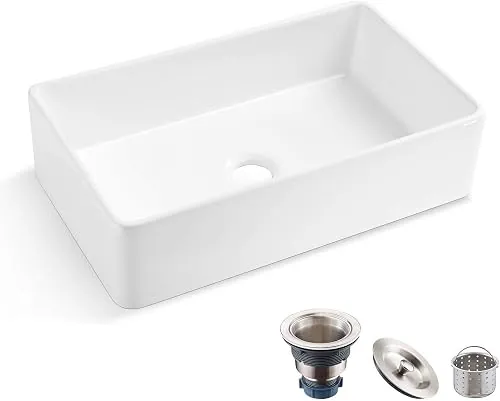
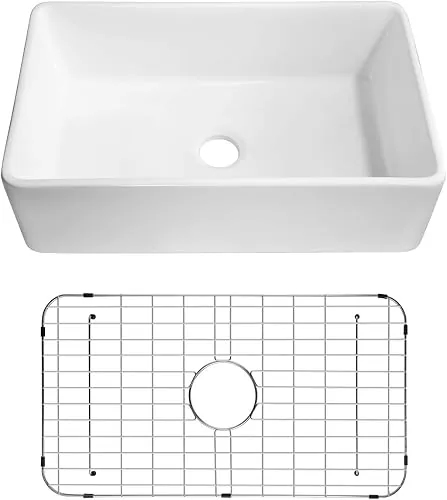
Popular Ceramic Kitchen Sinks
These two ceramic farmhouse sinks are among the best-selling models. Both give you the classic white apron look at a ceramic price.
Popular Porcelain Kitchen Sinks
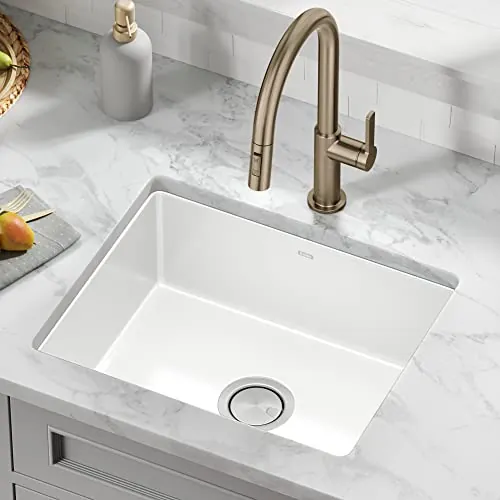
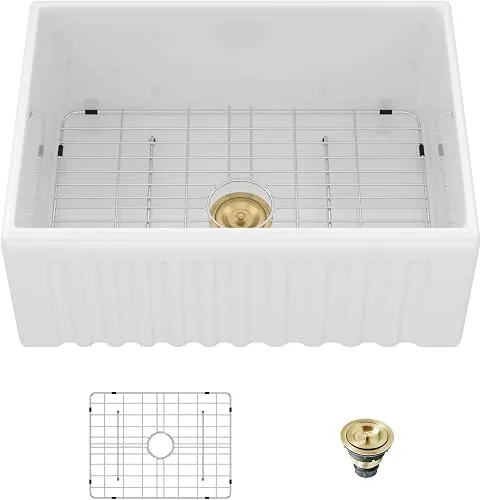
There is no single right porcelain sink for every kitchen, but these two are among the most sold on Amazon. Both are apron-front designs built for daily use.
FAQs
Why do we still use porcelain sinks?
Because they last. Many homes from the 1960s still have porcelain sinks that look good today. They are durable, easy to clean and have a classic look that is hard to beat.
How do you tell if a sink is porcelain or enamel?
A sink cannot be made entirely of enamel: enamel is only a finish fired onto a metal body, usually cast iron or steel (stainless steel sinks are left bare). Solid porcelain is very heavy and a magnet will not stick to it. If a magnet sticks, the sink is enamel-coated metal.
Is porcelain better than ceramic for a kitchen sink?
Porcelain is denser, less porous and more stain-resistant, so it handles heavy daily use better. Ceramic costs less and comes in more shapes. Choose porcelain for a busy kitchen and ceramic if budget comes first.
Can you repair a chipped porcelain or ceramic sink?
Small chips can be filled with a porcelain or enamel repair kit that matches the color of the sink. A chip on ceramic may show a different body color, so it is more visible and harder to hide.
Porcelain and ceramic sinks share a classic look, but porcelain is denser, less porous and tougher, while ceramic is lighter and cheaper. To tell them apart, start with the model number, then look at a chip and try a magnet. If you are buying new, pick porcelain for a hard-working kitchen and ceramic when price matters most.