
3/4 vs 1/2 Inch Shower Valve: Which Is Right for Your Bathroom?

By Julian Gill Updated · 7 min read
Disclosure: Some of the links in this article may be affiliate links, which can provide compensation to me at no cost to you. You can read our affiliate disclosure in our privacy policy.
In this article
- The Difference Between 3/4 and 1/2 Inch Shower Valves
- What the Two Sizes Have in Common
- Pros and Cons of Each Size
- 1/2 Inch Shower Valve
- 3/4 Inch Shower Valve
- How to Know What Size Shower Valve You Need
- The Most Popular 3/4 and 1/2 Inch Shower Valves
- Delta Faucet R10000-UNBXHF
- Kohler K-728-K-NA
- Mistakes to Avoid
- FAQs
The valve behind your shower handle decides how much water reaches the shower head and how warm it is. It works like the valve under a sink faucet, only hidden in the wall. Most homes use a 1/2 inch valve, and some bathrooms need a 3/4 inch one. Here is how to tell which you need before you open the wall.
Quick answer
A 1/2 inch shower valve is the right size for most showers with one head, or one head plus a handheld. Choose a 3/4 inch valve only when you plan to run several outlets at once, such as multiple heads and body sprays, and your supply pipes can feed it.
Key takeaways
- Size means volume: a 3/4 inch valve can deliver more gallons per minute (GPM) than a 1/2 inch valve.
- Size does not raise pressure: a bigger valve on 1/2 inch pipes gives you nothing extra.
- 1/2 inch is the standard: most shower and tub faucets run on 1/2 inch supply pipes.
- 3/4 inch is for multi-outlet showers: spa-style setups with body sprays and several heads.
- Match the valve to the pipes: and remember that 1/2 inch PEX is not the same inside size as 1/2 inch copper.
The Difference Between 3/4 and 1/2 Inch Shower Valves
The main difference is how much water the valve can pass. A 3/4 inch shower valve has larger ports, so it can supply more GPM than a 1/2 inch valve. That extra capacity matters when water has to reach several outlets at the same time.
With one shower head, the head itself limits the flow. A standard head is capped at 2.5 GPM, and a 1/2 inch valve supplies that easily. Putting a 3/4 inch valve behind a single head will not make the shower feel any stronger.
Valves come in sizes from 1/2 inch up to 2 inches, but for homes the choice is almost always between 1/2 and 3/4 inch. Both give good performance when they are matched to the job.
| Feature | 1/2 inch valve | 3/4 inch valve |
|---|---|---|
| Flow capacity | Enough for one head or head plus handheld | Higher, for several outlets at once |
| Typical supply pipes | 1/2 inch, the standard in most homes | 3/4 inch from the source |
| Best for | Standard showers and tub/shower combos | Spa showers, body sprays, multiple heads |
| Space in the wall | Compact, easier to fit | Larger body and fittings |
| Water heater demand | Normal | Higher when all outlets run |
| Parts and trim choice | Very wide | Narrower |
What the Two Sizes Have in Common
Both sizes do the same basic job: they mix hot and cold water and send it to the shower at a controlled flow. Both are available with one, two or three outlets. Both can be plumbed with copper or PEX, as long as you use the right adapters for the valve's connections.
Pros and Cons of Each Size
Best for most homes
1/2 Inch Shower Valve
The everyday choice. It matches the 1/2 inch pipes found in most bathrooms, fits easily in a standard wall and works with the widest choice of trim kits.
Best for spa showers
3/4 Inch Shower Valve
The choice for big custom showers. It can feed several heads and body sprays at the same time without each one going weak.
1/2 inch: pros
- Matches standard 1/2 inch supply pipes
- Small body that fits in tight walls, even with several outlets
- Huge choice of valves, cartridges and trim
- Plenty of flow for one head or a head and handheld
1/2 inch: cons
- Not enough volume for several outlets running together
- Outlets may lose strength in a multi-head spa setup
3/4 inch: pros
- Delivers more water for multi-outlet showers
- Keeps body sprays and extra heads strong at the same time
- The right base for a full custom shower system
3/4 inch: cons
- Needs 3/4 inch supply pipes to be worth it
- More water than needed when the valve serves just one outlet
- Larger pipe and fittings add cost and take more wall space
- Can empty a small water heater quickly
How to Know What Size Shower Valve You Need
Your existing plumbing makes most of the decision for you. Work through these points in order.
- Count your outlets
One shower head, or a head plus a handheld that you switch between, is a 1/2 inch job. Several heads and body sprays running together call for 3/4 inch.
- Check your supply pipes
Most shower and tub faucets use 1/2 inch supply pipes, so a 1/2 inch valve is the natural match. A 3/4 inch valve only pays off when 3/4 inch pipe runs all the way to it.
- Know your pipe material
A 1/2 inch PEX pipe is not the same as a 1/2 inch copper pipe: PEX has a smaller inside diameter. On a long PEX run feeding a big shower, that difference counts.
- Check your water pressure
Most homes in the United States have water pressure between 40 and 80 psi. Within that range, a 1/2 inch valve performs well for a standard shower. If your pressure is outside it, fix that first with a regulator or a pressure check.
- Think about the water heater
More outlets mean more hot water per minute. Make sure your heater can keep up before you size the valve for a spa shower.
The Most Popular 3/4 and 1/2 Inch Shower Valves
In our research, the most popular 3/4 inch valve is the Kohler K-728-K-NA. On the 1/2 inch side there are several great choices, including the Moen 2510, the Delta R10000-UNBXHF and the Delta R10000-UNBX.
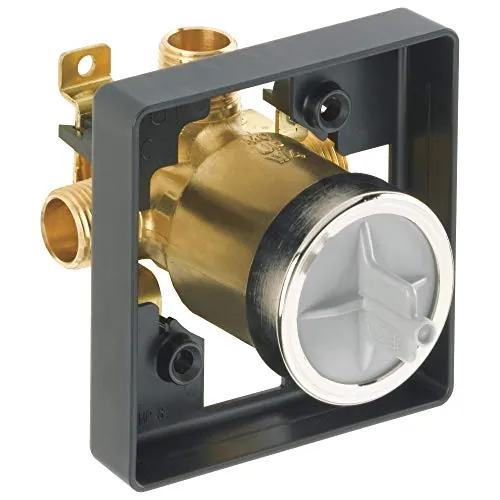
Want to change your shower trim later without touching the plumbing? This MultiChoice universal valve body accepts Delta's compatible trim kits, including single and dual-function thermostatic trims, so you can upgrade the look at any time. It is designed for showers only and has no tub outlet, which keeps it compact. Delta backs it with a limited lifetime warranty.
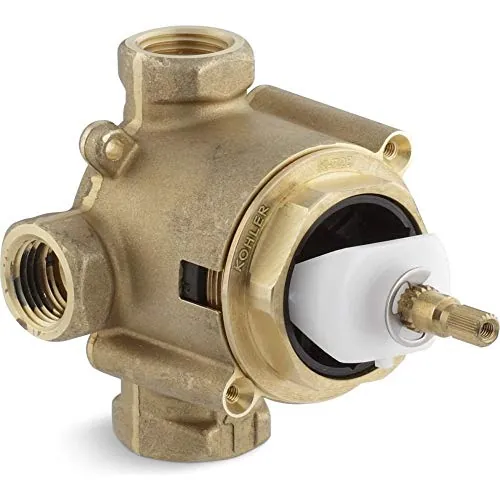
The Kohler MasterShower K-728-K-NA is a 3/4 inch 2- or 3-way transfer valve. It sends water to up to three separate outlets, so you can run one stream, switch to another or have both on at the same time. Kohler rates it at 18 GPM at 45 psi with one outlet and 20.8 GPM at 45 psi with two outlets.
We have also compared several of these 1/2 inch valves in detail: Moen 2510 vs 2520 vs 2570 vs 2590, Delta R10000 vs R11000 and Delta R22000 vs R22000WS.
Mistakes to Avoid
- Upsizing the valve to fix low pressure: a 3/4 inch valve on 1/2 inch pipes changes nothing. Find the real cause first.
- Mixing up PEX and copper sizes: same nominal size, different inside diameter.
- Forgetting the trim: buy a valve body that works with the trim style you want.
- Ignoring the water heater: a big multi-outlet shower can run out of hot water in minutes.
- Closing the wall without an access panel: you will want to reach the valve and its stops one day.
FAQs
Does a 3/4 inch shower valve increase water pressure?
No. A bigger valve does not raise your pressure. It lets more water through at the same time, which only helps when the pipes feeding it are also 3/4 inch and you run several outlets.
Do I need a 3/4 inch valve for a rain shower head?
Usually not. A single rain head or a head plus a handheld works well on a standard 1/2 inch valve. A 3/4 inch setup makes sense when several heads and body sprays run at once. See our rain shower head reviews for ideas.
Can I connect a 1/2 inch shower valve to 3/4 inch pipes?
Yes, with reducing fittings. The flow is then limited by the 1/2 inch valve, which is fine for one or two outlets.
How do I know what size my shower valve is?
Look at the pipes going into the valve behind the access panel, or find the brand and model number and check the spec sheet. Most homes have 1/2 inch valves.
For a standard shower or tub/shower, a 1/2 inch valve is the right size: it matches your pipes, fits the wall and gives plenty of flow. Step up to 3/4 inch only for a multi-outlet spa shower with 3/4 inch supply lines and a water heater that can keep up. Decide on the number of outlets first, then pick the valve.