
How Do I Stop My Two-Handle Kitchen Faucet From Leaking at the Base?

By Julian Gill Updated · 6 min read

Disclosure: Some of the links in this article may be affiliate links, which can provide compensation to me at no cost to you. You can read our affiliate disclosure in our privacy policy.
In this article
A puddle around the base of your kitchen faucet every time you rinse a plate is annoying, and it slowly ruins the countertop and the cabinet below. On a two-handle faucet with a swivel spout, the cause is almost always a set of worn O-rings. The good news: it is a cheap fix you can do in under an hour.
Quick answer
To stop a two-handle kitchen faucet from leaking at the base, shut off the water, loosen the spout coupling nut, lift off the spout and replace the worn O-rings. Coat the new O-rings with silicone grease, put the spout back and test for leaks.
Key takeaways
- O-rings are the usual culprit: they seal the swivel spout to the faucet body and wear out with every turn.
- It leaks only when the water runs: that pattern points straight to the spout O-rings.
- Silicone grease matters: it helps the new O-rings seal and lets the spout swivel smoothly.
- A constant drip is a different problem: if the faucet leaks while off, look at the cartridges instead.
Why a Two-Handle Faucet Leaks at the Base
On most two-handle kitchen faucets, the spout sits on top of the faucet body and turns from side to side. Rubber O-rings sit in grooves around the body, inside the spout, and keep the water in while still letting the spout swivel.
Each time you swing the spout, the O-rings rub a little. Over the years they dry out, flatten or crack, and water starts to sneak past them. Since the water only reaches them when the faucet is on, the leak shows up at the base while the water runs and stops when you shut it off.
Tools and Materials You Need
- Adjustable (crescent) wrench or strap wrench
- Soft rag or masking tape to protect the finish
- Flathead screwdriver
- Needle-nose pliers
- Replacement O-rings that match your faucet
- Faucet-safe silicone grease
- Old toothbrush and white vinegar for cleaning
Before you start
Turn off both the hot and cold supply valves under the sink, then open the faucet to release the pressure. Put a towel in the sink so small parts and screws do not fall down the drain.
How to Fix a Two-Handle Kitchen Faucet Leaking at the Base
- Turn off the water supplies
Close the hot and cold shut-off valves under the sink. Open both handles to drain the water left in the faucet.
- Loosen the coupling nut at the base of the spout
Turn the nut counterclockwise with an adjustable wrench. Wrap the jaws in a rag, or use a strap wrench, so you do not scratch the finish.
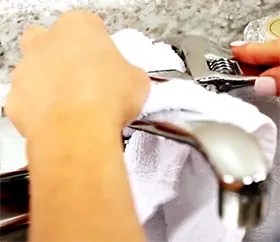
Loosen the coupling nut at the base of the spout. - Lift off the spout and find the O-rings
Twist the spout back and forth while you gently pull it up and off the faucet body. You will see the O-rings in grooves around the body. Most faucets have one or two, but some have three or four.
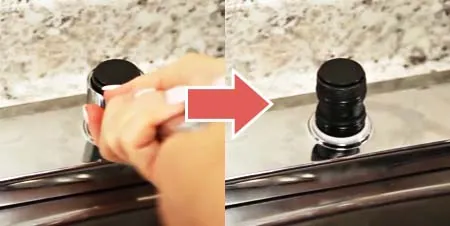
Twist the spout up and off to reach the O-rings. - Remove the old O-rings
Pry each O-ring out of its groove with a flathead screwdriver or needle-nose pliers. Work gently so you do not scratch the faucet body, because a scratch can cause a new leak.
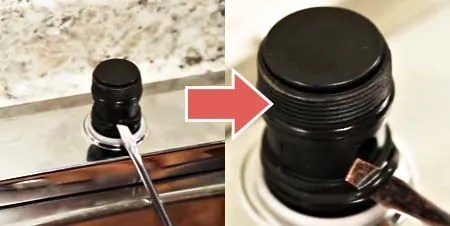
Remove the old O-rings one by one. - Clean the faucet body
Scrub the grooves and the inside of the spout with an old toothbrush and a little white vinegar to remove mineral deposits. Rinse and wipe dry.
- Grease the grooves and fit the new O-rings
Apply a thin layer of silicone grease to the faucet body where the O-rings sit. Roll each new O-ring into its groove, making sure it is not twisted or pinched.
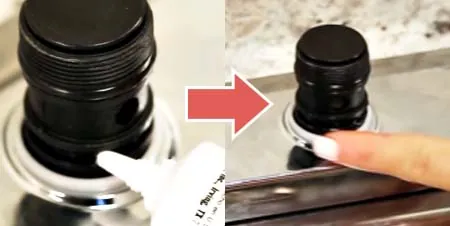
Grease the faucet body before fitting the new O-rings. - Grease the new O-rings
Once the O-rings are in place, coat them with another thin layer of silicone grease. This helps the spout slide on without rolling the O-rings out of their grooves.
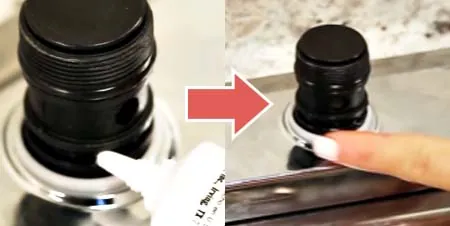
Coat the new O-rings before you put the spout back. - Reinstall the spout
Push the spout straight down over the O-rings with a gentle twisting motion. Thread the coupling nut by hand, then snug it with the wrench. Put back any screws, handles or decorative covers in the reverse order you removed them.
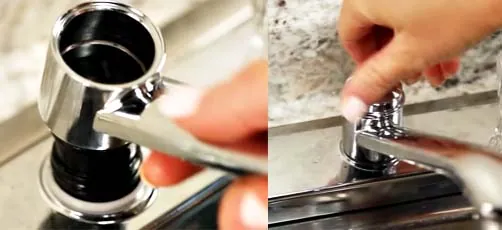
Put the spout and covers back in reverse order. - Turn the water back on and test
Open the supply valves slowly. Run hot and cold water, swing the spout from side to side and check the base with a dry paper towel.
Still Leaking? Troubleshooting
| Symptom | Likely cause | What to do |
|---|---|---|
| Leaks at the base only while running | Worn or wrong-size spout O-rings | Replace with exact-match O-rings and grease them |
| Drips from the spout when off | Worn cartridge or seat washer | Replace the cartridge on the leaking side |
| Water around a handle | Worn cartridge O-ring or loose bonnet nut | Tighten the nut or replace the cartridge |
| Water in the cabinet below | Loose supply line or mounting nut | Tighten the connection or replace the supply line |
| Leak returns right after new O-rings | Crack or corrosion in the faucet body | Replace the faucet |
When the Cartridge Is the Problem
The cartridge controls the flow of water through each handle. If the faucet keeps dripping even when both handles are off, the O-rings are not the issue. A worn or damaged cartridge cannot shut the water off fully, so replace the cartridge on the side that leaks. Turn the hot side off at the valve first to find out which side it is.
When to Replace the Whole Faucet
If new O-rings do not stop the leak at the base, look closely at the faucet body near the spout. A tiny crack in the body or the stem near the base lets water out no matter how good the seals are. At that point, changing O-rings again will not help, and a new faucet is the real fix.
Common Mistakes to Avoid
- Skipping the grease: dry O-rings tear when you push the spout on.
- Using petroleum grease: it can make rubber swell and fail.
- Overtightening the coupling nut: snug is enough, and too much force can crack plastic parts.
- Scratching the grooves: a gouge next to the O-ring creates a new leak path.
- Forgetting to check under the sink: rule out supply line leaks before you open the faucet.
FAQs
Why does my kitchen faucet only leak at the base when it is running?
Water reaches the spout O-rings only when the faucet is on. If they are worn, water squeezes past them and pools at the base. Replacing the O-rings usually stops it.
Can I use plumber's grease instead of silicone grease?
Use a silicone grease that is safe for faucets and drinking water. Petroleum-based grease can make rubber O-rings swell and fail early.
How do I find the right O-rings for my faucet?
Take the old O-rings and the spout to the hardware store, or look up the faucet brand and model for an exact repair kit. Size and thickness both matter.
What if water is leaking under the sink, not on top?
Check the supply line connections and the faucet mounting nuts under the sink first. A drip there is not an O-ring problem.
Is it worth fixing an old faucet or should I replace it?
O-rings are cheap and quick to replace, so try that first. If the faucet body is cracked or corroded, or the leak returns right away, a new faucet is the better fix. Our guide to the best two-handle kitchen faucets can help you choose one.
A two-handle kitchen faucet leaking at the base almost always needs new spout O-rings, and the job takes less than an hour with basic tools. Match the O-rings exactly, use silicone grease and test with the spout swinging both ways. If the leak comes back right away, check the faucet body for a crack and plan to replace the faucet.